
Monday, May 6, 2013

Sunday, April 21, 2013
Thank you!
Elated to have been chosen as one of the Top 30 Healthcare Blogs of 2012 over at Top Masters in Healthcare

Also check out this feature over at The Goldberg Files: Frustration in Medical School.
Thanks everyone for the positive feedback and stay tuned for more of my ramblings that delve into the highs and lows of preping for step 1.
Saturday, April 20, 2013
Note To (Future) Self
As a student I often find myself wondering how a professor or an attending could have the expectations that they do for us. I am particularly perturbed by this because I know for a fact that at one point they were in my very shoes. How then could they have forgotten how it feels to be on the other side? I am writing this post in hopes that my future self will stay connected to this, to remind myself as I trek through this journey where it all began:
Two days. Geez. I'm getting a little concerned that I'm going to know too much for this test. Seriously, 48 hours to cover this material? Thats more than enough. TV break. Review notes. Sleep
One day. Oh my god. What happened? I had three days, now theres 24 hours. If I sleep four hours that gives me 20 hours to review. Theres about five sections. Four hours per section. That doesn't seem like enough. I start frantically flipping through the pages of the text book realizing five minutes in that I have absorbed nothing. I'm just flipping. Where is the day going? Its already 1 pm. I woke up at 7. By now I should have finished reviewing half the material. I start counting: 1 pm, 2 pm, 3 pm . . . . 11 pm, 12 am, 1 am. Thats twelve hours.
Okay good. 12 hours, that should be enough.
Somehow its 8 pm. I've managed to eat my way through a bag of candy and 3 cans of soda. All of a sudden totally irrelevant, menail tasks became high priority. I absolutely had to reorganize the bathroom drawer. It was happening before I could stop and I had to finish. Its okay, I've gone through most of the material.
There is an ebb and flow to the panic and serenity. A little dance, my heart rate fluctuates between tachycardia and bradycardia. One second its beating in my ears as I see the minutes of sleep slowly slipping away as the night grows closer and my pile of work remains the same. Another I feel on top of the world, envisioning a 99%. High pass for me. Stress. Relax.
Finally I decide I need some sleep. I'm not one of those people who can pull an all-nighter. I need a little shut eye. I drift off to sleep with a page of notes clutched in my fist.
The clanging of my cell phone awakens me from a non restorative sleep and I bound out of bed as the panic washes over me again. Two hours. Theres only two hours left. Is any of this actually going to stick in my brain now? Should I just stop? No. I know these little details I can't remember, if I can just come up with a way to remember them. Some mneomonic: krazy kittens gurgling the night. There is no way I'm going to remember all of this minutia, there is no way they're going to ask about that.
As I reach the exam room the stress reaches its zenith as I pick up bits and pieces of other peoples conversations. Every so often I heard a tidbit that I don't know and a fresh wave of panic washes over my body. Its too late now--I'll just have to guess if that comes up on the test.
"You may begin"
I hate that feeling. The on where you remember where the answer is. Its on the bottom right corner of the 3rd page, you highlighted it and scribbled a note next to it. Thats all you know.
Thats the worst. When you feel like you should have studied just a little bit more. If you could have just pushed yourself a little bit harder. Then you wouldn't be sitting here with an exam in front of you and absolutely having to guess on questions.
Somehow your body goes into exam mode, you just start churning out answers. The test taking monster inside you takes over. Process of elimination and educated guesses slowly dilutes down to sheer dumb luck and guessing.
The walk home from the exam is awful. First you have to escape the group of students bickering about question #68. How do they even remember? I don't want to know. I jam my earbuds in my ears and high tail it out of there.
On my walk home I pull out my slightly crumpled study guide and race to the bottom of the 3rd page, where I highlighted and scribbled a note. IL-10. Thats what it was. How could I not remember? There's something wrong with me.
What if somehow I literally answered every question wrong? Statistically pretty unlikely but even at 25% would be awful. What if I fail? What am I going to do? I thought I studied, I thought I knew the material.
I hope they post grades soon.
3 days later . . . .pass. Phew. Wasn't so bad was it?
I understand that some of this is a part of the package. Medical school is a grueling undertaking I juts wish more attendings and professors could take a second to reflect on what it felt like to be where we were--just to ease the pain for us a little bit.
They say "be the change you wish to see". Someone check in with me in 20 years and see how thats going.
***
The test is in 3 days, no big deal. Study. Flip through notes. Eat. Where did the day go? Dinner. Yawn. Two more days. Sleep.Two days. Geez. I'm getting a little concerned that I'm going to know too much for this test. Seriously, 48 hours to cover this material? Thats more than enough. TV break. Review notes. Sleep
One day. Oh my god. What happened? I had three days, now theres 24 hours. If I sleep four hours that gives me 20 hours to review. Theres about five sections. Four hours per section. That doesn't seem like enough. I start frantically flipping through the pages of the text book realizing five minutes in that I have absorbed nothing. I'm just flipping. Where is the day going? Its already 1 pm. I woke up at 7. By now I should have finished reviewing half the material. I start counting: 1 pm, 2 pm, 3 pm . . . . 11 pm, 12 am, 1 am. Thats twelve hours.
Okay good. 12 hours, that should be enough.
Somehow its 8 pm. I've managed to eat my way through a bag of candy and 3 cans of soda. All of a sudden totally irrelevant, menail tasks became high priority. I absolutely had to reorganize the bathroom drawer. It was happening before I could stop and I had to finish. Its okay, I've gone through most of the material.
There is an ebb and flow to the panic and serenity. A little dance, my heart rate fluctuates between tachycardia and bradycardia. One second its beating in my ears as I see the minutes of sleep slowly slipping away as the night grows closer and my pile of work remains the same. Another I feel on top of the world, envisioning a 99%. High pass for me. Stress. Relax.
Finally I decide I need some sleep. I'm not one of those people who can pull an all-nighter. I need a little shut eye. I drift off to sleep with a page of notes clutched in my fist.
The clanging of my cell phone awakens me from a non restorative sleep and I bound out of bed as the panic washes over me again. Two hours. Theres only two hours left. Is any of this actually going to stick in my brain now? Should I just stop? No. I know these little details I can't remember, if I can just come up with a way to remember them. Some mneomonic: krazy kittens gurgling the night. There is no way I'm going to remember all of this minutia, there is no way they're going to ask about that.
As I reach the exam room the stress reaches its zenith as I pick up bits and pieces of other peoples conversations. Every so often I heard a tidbit that I don't know and a fresh wave of panic washes over my body. Its too late now--I'll just have to guess if that comes up on the test.
"You may begin"
I hate that feeling. The on where you remember where the answer is. Its on the bottom right corner of the 3rd page, you highlighted it and scribbled a note next to it. Thats all you know.
Thats the worst. When you feel like you should have studied just a little bit more. If you could have just pushed yourself a little bit harder. Then you wouldn't be sitting here with an exam in front of you and absolutely having to guess on questions.
Somehow your body goes into exam mode, you just start churning out answers. The test taking monster inside you takes over. Process of elimination and educated guesses slowly dilutes down to sheer dumb luck and guessing.
The walk home from the exam is awful. First you have to escape the group of students bickering about question #68. How do they even remember? I don't want to know. I jam my earbuds in my ears and high tail it out of there.
On my walk home I pull out my slightly crumpled study guide and race to the bottom of the 3rd page, where I highlighted and scribbled a note. IL-10. Thats what it was. How could I not remember? There's something wrong with me.
What if somehow I literally answered every question wrong? Statistically pretty unlikely but even at 25% would be awful. What if I fail? What am I going to do? I thought I studied, I thought I knew the material.
I hope they post grades soon.
3 days later . . . .pass. Phew. Wasn't so bad was it?
***
Panic. Fear. Pressure. Self doubt. Confusion. Restlessness. Sheer exhaustion. Those are all a part of this temporary condition but the fact of the matter is to us, at that particular moment they are all too real.I understand that some of this is a part of the package. Medical school is a grueling undertaking I juts wish more attendings and professors could take a second to reflect on what it felt like to be where we were--just to ease the pain for us a little bit.
They say "be the change you wish to see". Someone check in with me in 20 years and see how thats going.
Monday, April 15, 2013
Comic Relief I
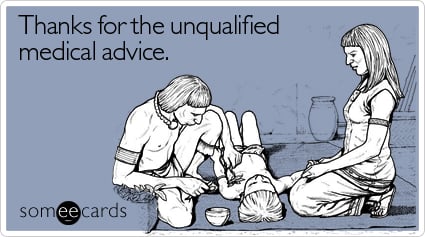 |
| Some of my classmates can't resist the urge to already be appending an MD to the end of their names--this is how I feel about it. Have any burning questions about med school? About classes, life, professors, family, lectures? Anything at all feel free to post a comment or shoot an e-mail at WaitingForMD15@gmail.com |
Thursday, April 11, 2013
Teachable Moments III: Harm Reduction
I happily trotted through the front door of the clinic and planted myself in front of the elevator waiting to go up. Although many students complained that their preceptors didn't know their names or didn't acknowledge them my experience was completely the opposite.
Dr. Parker was fantastic. Not only was I clinically useless but mostly incompetent but he never made me feel that way. He was kind, he was warm and he had this way of being reassuring that not only gave you confidence in him but in yourself, just for under his guidance.
A long time patient of Dr. Parker's, we'll call her Maria, came into the office for the 3rd time to finally be given a clinical diagnosis of hypertension. Her BP was off the charts (in retrospect probably it wasn't that off the charts because if it was it would have been malignant hypertension--see me dropping that M2 knowledge--and we would have called and ambulance to take her to the hospital). The obvious answer here was to start her on some pharmacotherapy and then make sure we could assure some compliance to keep her within a healthy range.
Much to my surprised Dr. Parker turned to her and asked what she thought.
Maria responded, "You know doctor, I really don't want to take a pill. I know its really high. I see that, but that is just not something that I want to do. What are my options?"
"Well if we can get you a little bit more active and check in for another BP reading and see if its declined maybe we can hold off on taking a medication," said Dr. Parker.
For the next ten minutes Maria shared that some ladies at work had been walking a few times around the block at lunch time and doing yoga after work two days a week. Dr. Parker and her decided she would try to get on this regimen with them and if the next time she came in it was still elevated she would choose to take the medication.
In my head I was screaming. She had high blood pressure! She needed to take medicine to bring that down otherwise . . . and that was when I figured it out. Otherwise what? She had been walking around with this pressure for a while another week or two wasn't going to kill her, but giving her the opportunity to make a lifestyle change could alter the course of her life, could save her.
Too many of us, medical students I mean, are the type of people that see a problem, synthesize a solution and implement it in rapid succession. Slowing that down, breaking the solution down into incremental chunks is a challenge for me. I had the opportunity to witness a harm reduction principle in motion, before my very eyes. For those of you who aren't familiar with the term it is essentially the idea that when you're wresting with a very severe outcome from an adverse event, any small decrease in the adverse event is a great. Allowing free needle exchanges for IV drug users in order to reduce the transmission of HIV and Hepatitis C by infected needles is a direct correlate of this public health principle.
Dr. Parker met her where she was. She wasn't ready to take a medication but she was ready to discuss adding some physical activity to her life. If that didn't work or she wasn't happy with that outcome he would be there to guide her down another path.
At the time I left the clinic that day I was still baffled as to why the so obvious solution was not implemented immediately--but after some reflection I realized that making the conscious choice to delay use of that solution exemplified far higher level thinking.
Dr. Parker was fantastic. Not only was I clinically useless but mostly incompetent but he never made me feel that way. He was kind, he was warm and he had this way of being reassuring that not only gave you confidence in him but in yourself, just for under his guidance.
A long time patient of Dr. Parker's, we'll call her Maria, came into the office for the 3rd time to finally be given a clinical diagnosis of hypertension. Her BP was off the charts (in retrospect probably it wasn't that off the charts because if it was it would have been malignant hypertension--see me dropping that M2 knowledge--and we would have called and ambulance to take her to the hospital). The obvious answer here was to start her on some pharmacotherapy and then make sure we could assure some compliance to keep her within a healthy range.
Much to my surprised Dr. Parker turned to her and asked what she thought.
Maria responded, "You know doctor, I really don't want to take a pill. I know its really high. I see that, but that is just not something that I want to do. What are my options?"
"Well if we can get you a little bit more active and check in for another BP reading and see if its declined maybe we can hold off on taking a medication," said Dr. Parker.
For the next ten minutes Maria shared that some ladies at work had been walking a few times around the block at lunch time and doing yoga after work two days a week. Dr. Parker and her decided she would try to get on this regimen with them and if the next time she came in it was still elevated she would choose to take the medication.
In my head I was screaming. She had high blood pressure! She needed to take medicine to bring that down otherwise . . . and that was when I figured it out. Otherwise what? She had been walking around with this pressure for a while another week or two wasn't going to kill her, but giving her the opportunity to make a lifestyle change could alter the course of her life, could save her.
Too many of us, medical students I mean, are the type of people that see a problem, synthesize a solution and implement it in rapid succession. Slowing that down, breaking the solution down into incremental chunks is a challenge for me. I had the opportunity to witness a harm reduction principle in motion, before my very eyes. For those of you who aren't familiar with the term it is essentially the idea that when you're wresting with a very severe outcome from an adverse event, any small decrease in the adverse event is a great. Allowing free needle exchanges for IV drug users in order to reduce the transmission of HIV and Hepatitis C by infected needles is a direct correlate of this public health principle.
Dr. Parker met her where she was. She wasn't ready to take a medication but she was ready to discuss adding some physical activity to her life. If that didn't work or she wasn't happy with that outcome he would be there to guide her down another path.
At the time I left the clinic that day I was still baffled as to why the so obvious solution was not implemented immediately--but after some reflection I realized that making the conscious choice to delay use of that solution exemplified far higher level thinking.
Thursday, November 15, 2012
(Re)learning How To Talk to People
(as always any and all names have been altered/deleted to
protect the privacy and anonymity of all parties involved)
By
now the white coat has become kind of old hat. I can’t believe I’m saying that because literally one year
ago I regarded this addition to my wardrobe the crowning jewel—too often I now
find it crumpled in a heap at the bottom of my bag . Its interesting to me how quickly we readjust and more
interestingly how quickly we regain the same level of dissatisfaction we were
at before a “significant” life event.
My whole life I feel like I’ve been counting down till med school and
now I’m here and honestly I feel the same. This is a matter of perspective and the dilemma of being
unable to observe your life from the outside looking in really resonates here
with me. I can’t wait to be an
attending but for now that seems like a lifetime away which was underscored by
my realization of how incomplete my own clinical knowledge bank is and even further
how immature my clinical judgment is.
I
knocked on the patient’s door and
gently pushed the door open to enter the room with my best attempt at a
friendly smile. The patient was
seated the armchair next to his bed in his washed out blue hospital gown and
green socks with the grippy lines on the bottom. He motioned me over and I took a seat perched on the edge of
his hospital bed.
“Hi my name is _________ and I am at second year
medical student at ___________,
and I was wondering if it would be okay if I ask you some questions about what
brought you to the hospital?” I said with a little too much enthusiasm, even I
caught myself off guard.
He responded “Sure, go ahead”
“Mr. _______? Is that correct?,” I continued
“Yes”
“And how would you prefer I address you?”
“Pete is fine”
“Okay Pete, thank you for allowing me to do this so
lets get started”
For
those of you who have been following me through this journey you will know how
strongly I feel about asking that question (click here to see an old post regarding the same topic: Don't Call Me Bob).
From
there I went through the CC (chief complaint) and HPI (history of present
illness) and am finding OLDCARTS (onset, location, duration, character, aggravating
factors, relieving factors, timing, severity) to be a very useful pneumonic in
keeping the HPI in order. It feels
like something that will become more natural as my training progresses but for
the time being I need a structure to follow so I don’t miss something. A post of clarification of terms will
be forthcoming.
We
discussed the clinical course of Pete’s condition and his situation was not the most ideal for an M2 to be investigating because he had been admitted to the hospital
due to some post-surgical complications, but we made it work. I managed to wade my way through the remainder of the complete history
punctuating that with a full ROS (review of systems) rapid fire in a way that
probably made it impossible for me to glean any abnormalities even if they were
present. Quickly glancing through
my notes I saw that I had collected all of the information I needed to do the
complete write up that was required and turned to Pete and thanked him for his
spending the time doing this with me.
Before I left I did something that I’m trying to make a habit of doing
with all patients I see, I turned to him and said “Pete, if it wasn’t for
patients like you none of us would ever learn anything or become better
doctors. Can you tell me what I
can do, as a future physician, to make sure my patients know that I care? And
can you tell me how I did?”
Although
you have to use your judgment based on the patient’s conditions if they would
be willing or able to engage in this discussion with you but I have found for
the most part they are exceptionally receptive to this. Shockingly to me I have learned the most about the patient’s medical
conditions and personal lives in this follow up conversation. This is after the “clinical encounter”
is done. It floors me to know that
there is this huge untapped potential that is accessible to me that for some
reason in my clinical persona suddenly become obfuscated.
For
now I foresee the largest challenge at this juncture of my training, and arguably
indefinitely into my future, will be how to temper my personality effectively
into my clinical persona.
Retaining a friendly demeanor and having interactions with patients that
are based on trust and understanding while keeping site of the clinical goals, necessities
and very real time constraints seems like a very difficult and delicate balance.
Sunday, November 11, 2012
Teachable Moments II: Low incidence ≠ Low Importance
One of the most interesting aspects of second year is the team based learning components that are usually led by a physician who is a specialist on the particular topic we are studying (ie dermatopathology is taught by dermatologists). These sessions are interactive and allow us to exercise some applications of the knowledge we have learned. I really appreciate the higher percentage of MDs associated with our curriculum now versus first year that is very PhD heavy. This isn't a criticism but rather an observation but is to be expected with a first year focus on basic science while second year starts to diffuse a serious clinical background into our learning.
While working through a patient case regarding some highly rare disease we all were disgruntled at the professor for having chosen something that was so unlikely. One classmate raised his hand and voiced this concern: what's the point of talking about something that is so rare. The professor's response to this is something that really resonated with me he said
"just because a disease is rare does not mean that it is rare for that patient"
It really hit me what those words meant and why we learn all of the minutia that we do. Someone somewhere has this and if that someone happens to wander into my office I want to have the ability to help--to identify, to diagnose, to treat--with humanity. Thats what got me, it was a reminder of the humility and humanity that is so quickly drowned out in a sea of lab values and patient findings.
When you step outside the house and its raining your first thought probably isn't welllll the chances of precipitation were only 25% so the fact that i'm 100% sure its currently raining is bothering me less. To always be cognizant of each and every patient as a person, however cheesy and obvious that sound, is a principle I will strive to uphold in my career.
I have to admit that I never expected to be sitting in a classroom being lectured at and having that shape my clinical perspective, but it has. Bringing physicians to us in a learning capacity provides us a tremendous asset in bridging the gap between book learning and clinical experiences. That being said I think the most lasting and impactful lessons I am learning are when someone who has been a doctor for 30 years passes on a pearl like this one. All day people teach at me how to read an EKG, how to differentiate between crackles and rales or how best to use an ophthalmoscope (left, left, left <-- more on that later) but what I want is someone to remind us how to do this while maintaining poise, grace and ultimately respect for the people who we serve. I want more professors to remind us that becoming doctors doesn't gives us superhuman status, that it doesn't automatically grant us some kind of authority but instead we are being entrusted with an amazing responsibility.
for even more naive optimism and borderline preachy rhetoric see this old post
While working through a patient case regarding some highly rare disease we all were disgruntled at the professor for having chosen something that was so unlikely. One classmate raised his hand and voiced this concern: what's the point of talking about something that is so rare. The professor's response to this is something that really resonated with me he said
"just because a disease is rare does not mean that it is rare for that patient"
It really hit me what those words meant and why we learn all of the minutia that we do. Someone somewhere has this and if that someone happens to wander into my office I want to have the ability to help--to identify, to diagnose, to treat--with humanity. Thats what got me, it was a reminder of the humility and humanity that is so quickly drowned out in a sea of lab values and patient findings.
When you step outside the house and its raining your first thought probably isn't welllll the chances of precipitation were only 25% so the fact that i'm 100% sure its currently raining is bothering me less. To always be cognizant of each and every patient as a person, however cheesy and obvious that sound, is a principle I will strive to uphold in my career.
I have to admit that I never expected to be sitting in a classroom being lectured at and having that shape my clinical perspective, but it has. Bringing physicians to us in a learning capacity provides us a tremendous asset in bridging the gap between book learning and clinical experiences. That being said I think the most lasting and impactful lessons I am learning are when someone who has been a doctor for 30 years passes on a pearl like this one. All day people teach at me how to read an EKG, how to differentiate between crackles and rales or how best to use an ophthalmoscope (left, left, left <-- more on that later) but what I want is someone to remind us how to do this while maintaining poise, grace and ultimately respect for the people who we serve. I want more professors to remind us that becoming doctors doesn't gives us superhuman status, that it doesn't automatically grant us some kind of authority but instead we are being entrusted with an amazing responsibility.
for even more naive optimism and borderline preachy rhetoric see this old post
Subscribe to:
Posts (Atom)